Architecture and invariants
← Maintainer handbook · Classification · Database lifecycle · Security policy
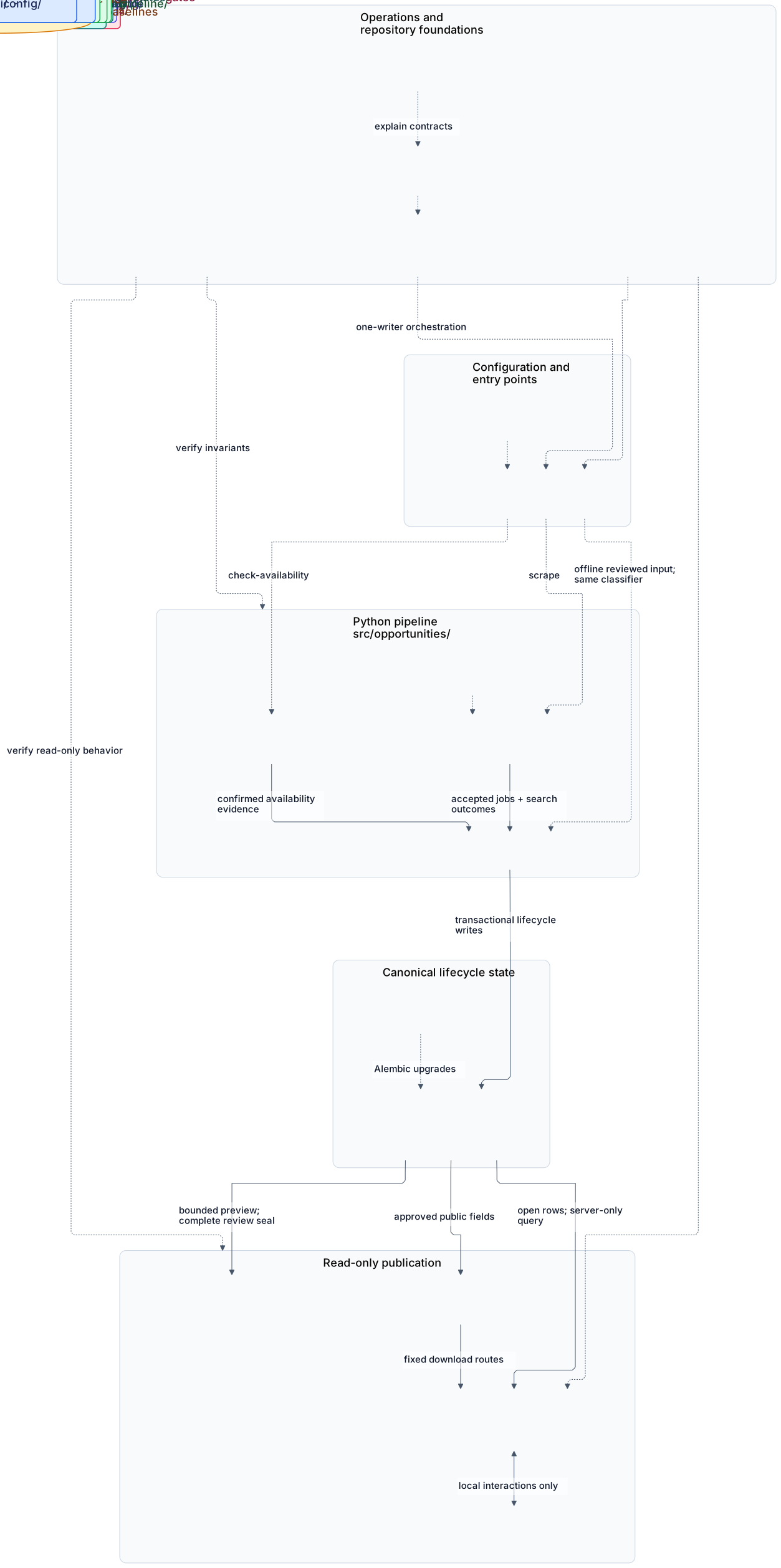
One permission-gated LinkedIn guest-HTML adapter feeds a deterministic classifier and one canonical SQLite lifecycle store. The website, API, feeds, downloads, and bounded README are read-only projections.
Open the annotated repository maps for five subsystem views and links to implementation. The overview below connects configuration, lifecycle state, public projections, and supporting tools.
Architectural principles
| Contract | Required behavior |
|---|---|
| Identity | Numeric LinkedIn job IDs uniquely identify listings; distinct IDs remain distinct |
| Canonical state | SQLite alone owns lifecycle truth; public files cannot reconstruct it |
| Strict acceptance | Ambiguous type, role, seniority, cycle/posting date, or geography is excluded |
| Safe closure | Search-page disappearance never closes a job |
| Failure isolation | Failed searches record diagnostics, not lifecycle mutations |
| One writer | Canonical application writes occur through Repository; Alembic owns schema evolution |
| Bounded access | Requests, retries, pages, results, concurrency, response sizes, and pacing remain limited |
| Unauthenticated source | No source credentials, cookies, browser collection, private endpoints, or evasion |
| Read-only projections | Presentation does not collect, classify, migrate, or mutate canonical state |
| Determinism | The same evidence and settings produce the same classification and publication |
These are contracts, not suggestions. Review SECURITY.md before proposing a changed boundary.
Component map
| Owner | Path | Responsibility |
|---|---|---|
| CLI | src/opportunities/cli/ |
Preconditions, command input, orchestration, output and exit codes |
| Configuration | src/opportunities/config/, configs/ |
Settings, rules, recursive search registry and limits |
| Transport | src/opportunities/scrapers/http.py |
Authorization interlock, approved endpoints, no redirects/cookies, bounded retries and pacing |
| Source adapter | src/opportunities/scrapers/linkedin.py |
Guest URL construction, cards, detail identity, structured metadata and closure alerts |
| Normalization | src/opportunities/normalization/ |
Stable title and conservative location signals |
| Classification | src/opportunities/pipeline/classification.py |
Pure acceptance/rejection decisions |
| Collection orchestration | src/opportunities/pipeline/runner.py |
Bounded concurrent discovery, isolated outcomes, serialized persistence |
| Collection quality | src/opportunities/pipeline/data_quality.py |
Pure aggregate drift analysis and publication-gate findings |
| Availability | src/opportunities/pipeline/availability.py |
Bounded rotating explicit evidence audit |
| Persistence | src/opportunities/database/, migrations/ |
Transactions, provenance, lifecycle, bounded aggregate quality baselines and schema evolution |
| Projections | src/opportunities/readme.py, readme_localization.py, public_exports.py, search_registry_docs.py |
Localized generated regions, public serialization and validation |
| Website | site/src/lib/, site/src/components/ |
Server-only read-only queries; client-only interaction |
| Operations | scripts/, .github/workflows/ |
Verified recovery, validation, review handoff and release-pointer deployment |
Read one listing through the code
For a first code review, follow one listing rather than reading every module in directory order:
- Start with
CollectionPipeline.runinsrc/opportunities/pipeline/runner.py. It connects search scheduling, fetching, classification, and per-search persistence. The CLI insrc/opportunities/cli/app.pyadds command preconditions and publication gates; it is not the place to start learning the classification rules. - Follow
LinkedInScraper.scrapeinsrc/opportunities/scrapers/linkedin.pyintoparse_search_pageandparse_job_detail. Then readHttpFetcher.get_textinscrapers/http.pyfor the separate authorization, pacing, retry, and source-stop policy. - Read
Classifier.classifyalongsidenormalize_locations. Trace an accepted role and a rejected one throughtests/unit/test_classification.py; the tests distinguish discovery hints from sufficient publication evidence. - Follow
Repository.persist_successinsrc/opportunities/database/repository.py. Read the stale-observation and failed-transaction cases intests/integration/test_repository.pybefore changing lifecycle behavior.tests/integration/test_runner.pyconnects these boundaries with mocked collection and a real disposable database. - Follow an open row into
public_exports.pyandreadme.py, then intosite/src/lib/opportunities.ts. The website does not rerun classification. Its directory component delegates URL state touse-opportunity-directory.tsand private browser state touse-local-opportunities.ts.
For an offline end-to-end example, read scripts/testing/create_site_fixture.py: it creates synthetic listings through real migrations, repository methods, and exporters. Run it only through the documented fixture setup, never against production state. Use the test inventory to find the failure cases for a particular boundary.
Discovery is not acceptance
Search YAML controls where to look, not what may be published. Search cards undergo company/title prefilters before bounded detail fetching. Detail responses must independently contain title and company identity; a current card cannot make a generic HTTP-success page valid. Detail location may fall back to card location.
Overlapping searches share in-flight detail requests by numeric ID. Completed response bodies are evicted; one cancelled search must not cancel a request another search uses. Accepted DiscoveredJob values cross the repository boundary only after normalization and classification.
Search registry owns discovery schema and pagination; Configuration owns transport tuning. Never add acceptance rules to the website, YAML workflow, or README renderer.
Failure isolation
Searches fetch within the existing concurrency bound, in oldest-completed order with stable registry ties, then outcomes persist in finish-time order. Each successful search commits independently, including its private scheduling timestamp. Failed and source-skipped searches never advance that timestamp. A failed search records bounded, sanitized diagnostics but does not upsert jobs, apply absence, confirm unavailability, or close rows. A partial batch preserves successful work.
HTTP 429 stops all new source requests. Completed searches or confirmed availability checks may qualify for partial publication, but other denials and independent failures block it. The source-access policy defines eligibility. An audit rate limit also prevents nightly scraping from starting.
Partial updates still require integrity, projection, and snapshot validation and manual review. Collection must also pass its quality gate. Neither partial nor blocked runs establish a full-registry quality baseline; audit-only runs produce no collection metrics or report.
Rotation becomes durable only through verified snapshots; the reviewed-state barrier still blocks new mutations while a partial proposal is unmerged. CLI exit codes are canonical.
The search start is a conservative observation lower bound: a detail page fetched early in a slow search must not overrule a newer observation merely because its search finished later. Repository stale-evidence guards and monotonic timestamps enforce this. Exact transitions, the separate rotating audit, and migrations belong to Database and lifecycle.
Public projections
| Projection | Owner and contract |
|---|---|
| Website | Short-lived read-only SQLite connections; all open rows and latest successful collection time; website engineering |
| API | Shared release selection, bounded inputs, and explicit field allowlists; listing queries and read-only dataset status; v1 contract |
| RSS / Atom feeds | Same read-only open rows, latest 50 entries, exact type/country/category filters, and escaped XML; subscriber guide |
| CSV / JSON / metadata | Python renderer selects approved fields, neutralizes CSV formulas, validates schema/bytes/counts/hashes, and atomically replaces files; download contract |
| READMEs | English and five translations share canonical counts, seals, and listing data with localized renderer-owned presentation; maximum five newest rows per employment type in each file |
| Registry documentation | Renderer owns the search-directory count block, not the surrounding guide |
Optional collection-time data-quality monitoring compares aggregate observations with recent matching runs and stores bounded counts through Repository. Its gate runs after search commits and can withhold publication, but never changes classification or rolls back lifecycle state. Reports contain no listing text or raw source responses; website and export projections do not read monitoring baselines. The CLI quality-report reference owns thresholds and scope.
The README includes a hidden SHA-256 seal covering every website-visible open row and the exact last-successful-collection timestamp, including rows outside its preview. Validation reconstructs both regions from SQLite using fixed presentation strings for each supported language and requires exact localized output equality. Rendering preflights all files before atomic per-file writes and preserves authored text; README localization defines file discovery and ownership. Automation's reviewed-state barrier prevents deploying unreviewed public state. A hash alone does not explain a change: review the sanitized artifact and protected evidence when necessary.
Coverage metrics are a separate generated region in Testing, owned by scripts/docs/coverage_docs.py. No production database is needed to refresh them.
Dependency direction
CLI → configuration / pipeline / repository / projection renderers. Pipeline → transport + parser / normalization + classifier / repository. Repository → models + database session. Website → read-only SQLite; downloads → fixed generated files. The parser does not write SQL, the repository does not parse HTML, and renderers do not discover jobs.
Maintainer add-job / add-jobs is an offline input path through the same classifier and repository upsert. It validates supplied facts but cannot authenticate them, rejects manual reopening of closed rows, and invents no search provenance. CLI owns the input contract; Database owns transaction semantics.
Browser-local state is not lifecycle state
Saved, applied, hidden, and visit timestamps exist only in browser localStorage. They contain IDs, not job metadata or application details, and never reach SQLite or the API. Website engineering owns storage semantics; Privacy owns the disclosure.
Extension policy
Focused searches, stricter classification with nearby rejection tests, sanitized fixtures, read-only views, accessibility improvements, and safer recovery checks can preserve these boundaries. Additional providers, source authentication/browser collection, multiple writers, server-stored application state, mutation APIs, user content, or new authentication surfaces require explicit architecture and security review. Do not introduce them as incidental refactoring.